The indictment of Mr. Hoang Trung, Deputy Minister of Agriculture and Environment, on charges of accepting bribes related to durian exports to China is not merely a story about the downfall of a single official at the ministerial level.
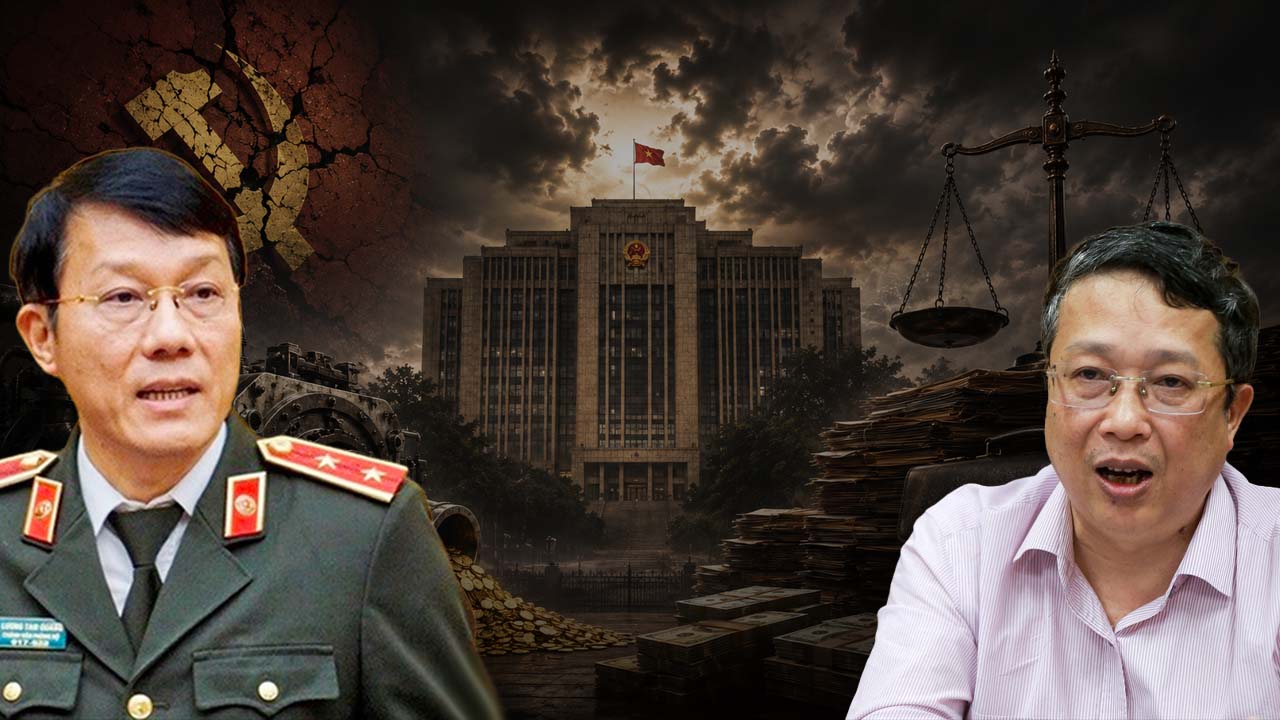
According to information from the C03 Investigation Agency of the Ministry of Public Security, Mr. Trung and Mr. Nguyen Quang Hieu are accused of abusing their positions to issue illegal policies and create a system of sub-licenses serving the interests of a special interest group, resulting in particularly large sums of illicit gains.
The allegations of interference in the system for issuing fraudulent inspection certificates, planting area codes, or the illegal buying and selling of packaging facility codes paint an alarming picture of the management of the durian business sector in Vietnam.
Although the court has not yet issued final rulings, C03’s findings indicate that the nature of the case goes far beyond the conventional concept of bribery.
According to legal experts, this involves a high-ranking official with the authority to enforce policies using his very position to erect a “toll booth”—like a BOT station—forcing anyone wishing to pass through to pay a fee.
Notably, the phenomenon of transforming state administrative authority into a form of private business asset is not unprecedented within Vietnam’s administrative system.
Although no one can provide an exact figure on how many officials like Deputy Minister Hoang Trung remain within the system, a series of major corruption cases exposed in recent years has revealed an alarmingly recurring pattern.
The Việt Á case involving former Health Minister Nguyễn Thanh Long, which centered on licensing and price-fixing for testing kits; the AIC case involving procurement contracts in Đồng Nai; or the SCB Bank case involving Ms. Trương Mỹ Lan, where the head of the State Bank of Vietnam’s Inspection Department accepted bribes to cover up violations.
Accordingly, all these cases converge on a single, core issue. That is: When the power entrusted by the state has been turned into a tool for leaders seeking to amass personal gains.
According to legal experts, when leaders in charge of critical areas—such as standards, licensing, or inspection—can bend procedures in exchange for material benefits, this constitutes a serious erosion of public power.
For this reason, the core question following every major corruption case goes beyond simply asking who received how much money; it must instead address the systemic weaknesses that created the loopholes enabling such behavior.
If there is indeed fraudulent issuance of inspection certificates or the trading of farm-area codes, such violations certainly could not exist based solely on the decision of a single individual—even if that person holds the rank of deputy minister.
This raises a pressing question regarding the internal control system, advisory responsibilities, transparency in the execution of public duties, and the ability to detect early on the misconduct of interest groups within the government apparatus itself.
As long as public administrative procedures remain overly bureaucratic, with “gray areas” lacking transparency as they do today, this creates opportunities for a “quid pro quo” system, and businesses seeking to survive are forced to “grease the wheels” for those in power; thus, arresting a few individuals who violate the law only addresses the tip of the iceberg.
The history of the fight against corruption has proven that a healthy system never assumes that everyone entrusted with power will be absolutely incorruptible.
On the contrary, an effective national governance system must be designed with a preventive mindset—meaning that even if someone seeks to abuse their power, they will face countless barriers that make it difficult to do so.
Unless transparency standards in policy-making are tightened and irrational sub-licenses are eliminated at their root, the risk of a similar scenario recurring in Vietnam will always remain.
Trà My – Thoibao.de